Dental work demands precision, concentration, and long periods of static sitting. During a molar restoration, a dentist may lean forward while rotating the neck toward a narrow operating field. That posture can feel harmless at first. Repeated daily, it may contribute to discomfort and reduced working tolerance.
The National Institute for Occupational Safety and Health identifies awkward posture, prolonged static loading, and repetitive work as important musculoskeletal risk factors. Dental professionals face all three. A systematic review published in the International Journal of Environmental Research and Public Health also found frequent neck, shoulder, and lower-back symptoms among dentists. These findings support ergonomic attention, but they do not prove that every expensive stool prevents injury. Evidence must guide the purchase.
So, is an ergonomic stool worth it for dentists? Often, yes—but only when it supports a complete ergonomic system. Seat height, pelvic stability, lumbar support, foot positioning, and easy movement all matter. The American Dental Association recommends neutral working posture and appropriate equipment adjustment, rather than relying on furniture alone. A saddle-style seat may open the hip angle. A poorly fitted one may create pressure and fatigue instead.
The following seven tips examine comfort, adjustability, durability, infection-control practicality, and clinical positioning. They also consider a less convenient truth: dentists differ in height, procedure style, and existing pain. One stool cannot suit everyone. A careful trial, ideally with guidance from an occupational health or dental ergonomics professional, remains more reliable than marketing claims. Small adjustments can matter. The best choice is the one that supports measured, repeatable movement throughout a real clinical day.
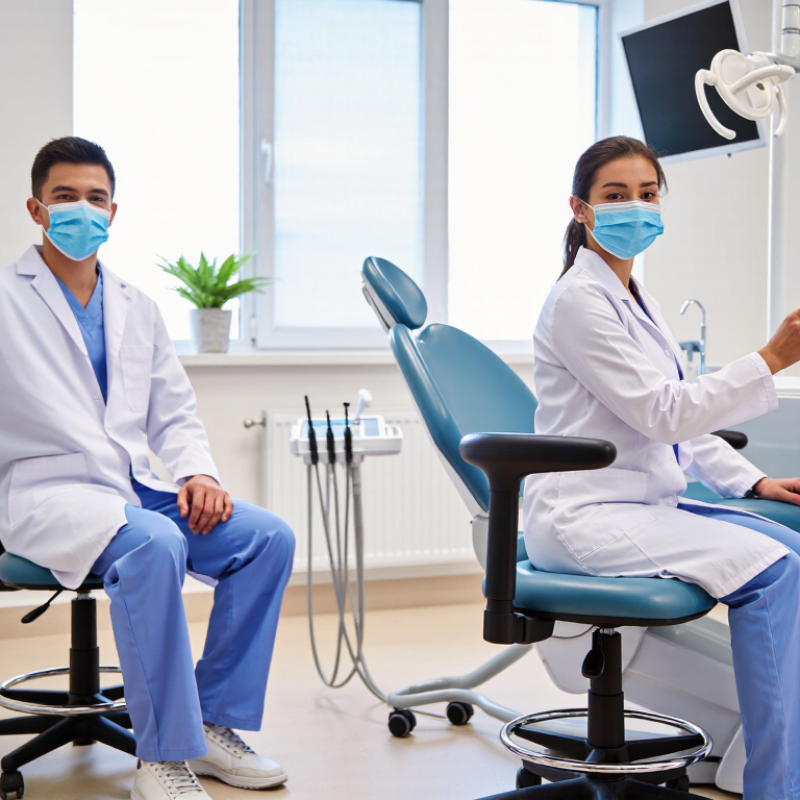
An ergonomic stool supports a dentist’s body during detailed, seated procedures. It usually offers adjustable height, controlled tilt, stable casters, and shaped seat support. Some models include a backrest, while others encourage balanced sitting without one. The correct design depends on the dentist’s height, working distance, and preferred posture.
Dentists use these stools to keep their hips, spine, shoulders, and feet better aligned. A suitable height can reduce excessive neck bending near the patient’s mouth. A supportive seat may also distribute pressure across the thighs and pelvis. Ergonomic assessments commonly recommend changing posture throughout the day, not holding one position for hours. Movement still matters.
Check seven practical details before choosing one: seat height, seat depth, tilt control, back support, foot stability, wheel movement, and cleaning access. The stool should move smoothly but remain stable during precision work. Its surfaces should tolerate routine clinical cleaning. Test it with your usual footwear and working position. Small differences matter.
An ergonomic stool is not a cure-all. Poor lighting, an awkward patient position, or an overextended reach can still create strain. I would not choose a stool by appearance alone. A brief trial may reveal pressure points that are invisible in a showroom. Even a well-designed stool may feel wrong after several long appointments. Reviewing posture with a qualified ergonomics professional can provide more reliable guidance.
An ergonomic stool is worth it only when it improves your working posture. The chair should let your hips sit slightly higher than your knees. This position can reduce pelvic rotation during long procedures. Your feet should remain stable, not dangle above the floor. A rounded seat edge may also reduce pressure behind the thighs.
Check your spine while simulating a real examination. Can you keep your neck near neutral while viewing the patient? Do your shoulders stay relaxed when reaching for instruments? The National Institute for Occupational Safety and Health links awkward, sustained postures with work-related musculoskeletal disorders. In 2023, the U.S. Bureau of Labor Statistics reported that musculoskeletal disorders represented 21% of private-industry days-away-from-work cases. That figure is not dental-specific, but it shows why small posture habits deserve attention.
Support must feel active, not restrictive. Look for adjustable lumbar support, seat height, tilt, and foot-ring position. Test every adjustment while wearing your normal clinical footwear. A stool that feels comfortable for five minutes may fail during a three-hour procedure. I would also compare your posture from the side, using a simple phone recording. It can reveal forward-head posture that feels invisible. Do not assume more cushioning means better support. Sometimes it only hides poor alignment. A careful trial matters more than attractive specifications.
| Tip | Evaluation Dimension | Evidence-Informed Benchmark | Why It Matters in Dentistry | Suggested Score (1–5) |
Practical Test |
|---|---|---|---|---|---|
| 1. Check Neutral Posture | Pelvic and spinal alignment | The pelvis should remain stable, the lower back should not be forced into excessive rounding, and the trunk should stay close to upright during routine procedures. | A neutral working position can reduce sustained loading on the lower back, neck, and shoulder muscles. | 1–5 | Sit for 10 minutes while simulating examination movements. Reject the stool if it causes persistent slouching, pelvic sliding, or lumbar discomfort. |
| 2. Verify Seat Height | Height range and foot contact | Both feet should rest securely on the floor or a stable foot ring. Knees should remain approximately level with, or slightly lower than, the hips without pressure behind the knees. | Correct height helps maintain hip stability and allows smooth repositioning around the patient. | 1–5 | Adjust the stool while wearing normal clinical footwear. Make sure the lowest and highest settings both support a stable working posture. |
| 3. Assess Lumbar Support | Backrest shape, height, and firmness | A backrest should support the lower back without pushing the torso forward or restricting close access to the patient. | Support is useful during longer appointments, but an oversized backrest may interfere with forward leaning and rotation. | 1–5 | Lean back lightly, then return to a working position. The backrest should support movement rather than lock the spine in one position. |
| 4. Evaluate Seat Design | Seat contour, width, and edge pressure | The seat should distribute pressure evenly, avoid hard contact behind the thighs, and allow frequent weight shifts without sliding forward. | Poor contouring can create discomfort and encourage static sitting or asymmetrical leaning during detailed work. | 1–5 | Test both upright and slightly forward positions. There should be no numbness, concentrated pressure, or need to brace against the floor. |
| 5. Test Adjustability | Height, tilt, backrest, and arm-support controls | Controls should be easy to reach, operate smoothly, and remain secure after adjustment. Independent adjustments are preferable to a single fixed setting. | Dentists change working distance, patient position, and visual angle throughout the day. | 1–5 | Adjust the stool while seated, without excessive twisting or standing up. Confirm that settings do not drift during use. |
| 6. Confirm Mobility and Stability | Caster movement, base design, and braking behavior | The base should remain stable during fine motor tasks while allowing controlled movement. Casters should roll smoothly without sudden slipping. | Controlled mobility can reduce repeated twisting and reaching, while excessive movement may compromise precision and safety. | 1–5 | Move laterally and forward on the clinic floor. The stool should not tip, catch, or roll unexpectedly when you apply light pressure. |
| 7. Use a Full-Shift Trial | Comfort, fatigue, and workflow compatibility | Evaluate the stool across short and long appointments, different patient positions, and both direct and indirect vision tasks. Comfort should remain consistent rather than declining quickly. | A stool may feel comfortable briefly but fail to support posture during a complete clinical schedule. | 1–5 | Record discomfort from 0–10 at the start, middle, and end of the trial. A meaningful reduction in fatigue is stronger evidence than initial softness. |
| Decision Guide: Add the seven scores for a total out of 35. | 29–35: Strong ergonomic fit | 22–28: Usable with adjustments | 7–21: Reassess before purchase | ||||
Note: The benchmarks are general ergonomic screening criteria, not a substitute for an individual assessment by a qualified occupational health or ergonomics professional.
A dental stool can be worth the investment, but comfort alone is not enough. Dental professionals often work with a bent neck, raised shoulders, and limited leg movement. A 2023 systematic review in the International Dental Journal reported that musculoskeletal symptoms commonly affected more than half of surveyed dental professionals. NIOSH also identifies awkward posture, repetition, and force as major ergonomic risks. A stool cannot correct every problem.
Tip 1: Check adjustability. Your hips should sit slightly higher than your knees. Keep both feet stable, not dangling.
Tip 2: Test the saddle or flat seat. A saddle design may improve hip position, but it can feel restrictive during longer procedures. Try sitting for at least ten minutes. Small discomfort matters.
Tip 3: Match the stool with your working height. The backrest should support movement, not push your torso forward. Keep elbows close to your body, with instruments within easy reach.
Tip 4: Look for controlled mobility. Casters should roll smoothly without making you chase the patient. Too much movement can reduce precision.
Tip 5: Adjust before treatment begins. Move the stool, patient chair, light, and tray together. This takes seconds.
Tip 6: Change posture regularly. Even a well-designed stool does not replace movement breaks. The FDI World Dental Federation encourages ergonomic awareness throughout clinical work.
Tip 7: Review your symptoms honestly. Persistent wrist, neck, or lower-back pain deserves professional assessment. A better stool may help, but it may not be the real answer. Ergonomics is still partly trial and error.
An ergonomic stool can influence more than a dentist’s sitting comfort. It can change pelvic position, trunk balance, and reach during prolonged procedures. NIOSH identifies awkward posture, static muscle loading, and repetitive movement as major ergonomic risks. These risks are common beside a dental chair.
Evidence shows why the issue deserves attention. Hayes and colleagues reported musculoskeletal symptoms among 83% of surveyed Australian dental hygienists over 12 months. Lower-back and neck discomfort were frequent complaints. A supportive stool cannot remove every risk, but adjustable height and a stable seat can reduce unnecessary leaning. A forward-tilting seat may also help maintain a neutral spine while accessing the oral cavity. Small adjustments matter.
Clinical performance may improve when discomfort demands less attention. A clinician who is not constantly shifting can maintain steadier hand control and clearer visual focus. However, the evidence is not perfect. Better seating alone does not guarantee improved treatment quality. Room layout, magnification, patient positioning, and scheduled micro-breaks also matter. In practice, the best stool is the one that fits the clinician’s body and procedure style, not the one with the most features. A short trial is sensible. Check hip angle, foot stability, lumbar support, and movement around the operatory. If the stool causes pressure behind the knees, it is probably not helping.
Is an Ergonomic Stool Worth It for Dentists?
When the Benefits Justify the Cost for a Dental Practice
Tip 1: Measure the clinical routine, not the catalog description. An ergonomic stool can support a neutral spine during long procedures. Its height should let the dentist keep both feet stable and elbows close to the body. A poorly adjusted stool may increase shoulder tension instead. In practice, small changes matter, especially during root canals or lengthy restorative work. Comfort is useful, but posture control is the real investment.
Tip 2: Calculate the cost against repeated discomfort. A premium stool may seem expensive beside ordinary seating. However, fewer painful interruptions can protect appointment flow and staff wellbeing. Dental ergonomics research links sustained awkward posture with musculoskeletal strain, although equipment alone cannot solve the problem. The dentist still needs movement breaks, proper lighting, and suitable instrument positioning. That part is often forgotten.
Tip 3: Test before purchasing several units. Let dentists use the stool through a full clinical session, not just five minutes. Check seat pressure, wheel stability, height range, and cleaning access. A two-week trial can reveal problems that showroom testing misses. It may also show that one design suits an operator but frustrates an assistant. The decision is not always obvious.
For a dental practice, the cost becomes easier to justify when the stool improves posture, reduces fatigue, and fits the team’s workflow. Document discomfort levels before and after testing. Review the results honestly. The most expensive option may not be the most suitable.
When musculoskeletal symptoms are common in dental work, an ergonomic stool may justify its cost when it supports neutral posture, stable positioning, and comfortable movement throughout the workday.
Reported one-year prevalence of musculoskeletal symptoms among dental professionals. The figures show why seating and posture are important practice considerations; they do not prove that an ergonomic stool alone prevents symptoms.
Source: Lietz J, Kozak A, Nübel H. Prevalence and occupational risk factors of musculoskeletal diseases and pain among dental professionals in Western countries: a systematic literature review and meta-analysis. International Journal of Environmental Research and Public Health. 2018;15(8):1742.
It supports seated work during detailed procedures. Adjustable height, seat shape, tilt, and stable wheels are common features.
A suitable stool helps align the hips, spine, shoulders, and feet. It may reduce neck bending near the patient’s mouth.
No. Poor lighting, awkward patient positioning, and long reaches can still create strain. It is not a cure-all.
Check height, seat depth, tilt control, back support, foot stability, wheel movement, and cleaning access. Small differences matter.
Not always. Some dentists prefer back support, while others balance comfortably without it. Body shape and working style should guide the choice.
Less discomfort may support steadier hand control and clearer visual focus. Better seating alone does not guarantee better treatment.
Test it with usual footwear and working positions. Move around the dental chair. Notice hip angle, foot stability, and pressure points.
Pressure behind the knees is a warning sign. Unstable feet, forced leaning, or restricted movement also suggest a poor fit.
It can help, especially when discomfort continues. A qualified professional may assess posture, reach, lighting, and room layout.
Not necessarily. The best stool fits the clinician’s body and procedures. I would not choose one by appearance alone.
An ergonomic stool is designed to support a dentist’s posture during long clinical sessions by promoting balanced sitting, reducing pressure on the lower back, and allowing smoother movement around the patient. When evaluating one, dentists should consider lumbar and pelvic support, seat comfort, height range, tilt control, stability, and ease of adjustment. The stool should fit the dentist’s working position without restricting access or encouraging awkward leaning.
Choosing the right model also involves testing it with everyday procedures, adjusting it before each appointment, and combining it with proper patient positioning and regular movement breaks. A suitable stool can improve comfort, concentration, and clinical performance while helping reduce fatigue over time. Ultimately, the answer to “is an ergonomic stool worth it for dentists” depends on individual needs, workload, posture habits, and budget, but the benefits may justify the cost when the stool is durable, adjustable, and consistently used correctly.

Derma Medical